Byron Shorebirds & Waterbirds


_________

Download Latest BBB Program Jan - June 2013
 (updated Feb 2013) PDF 35k
CLICK    HERE
_________

Both the 'Birds in Back Yards Seminar' held at the Byron Council Chambers on 9th April and the 'Beach-nesting Bird Workshop' held on Wednesday 3rd April were both well attended.
We would like to take this opportunity to extend an appreciation and a great thanks to all of you who made the days a success.

 
Workshop Speakers  LtoR,
Grannie McGuire, Megan Cullen, Tanya Fountain, Linda Brannian, Jan Olley, Lori Cameron(not pictured)

Feed-back from the workshop attendees have indicated that the information was great, they learnt a lot, and they really had a very enjoyable day.  The success of the day can be attributed to a joint effort in organization between Birdlife Australia, Birdlife Tweed, BBB members, the quality of the presentations and Byron Shire Council in allowing us the use of the Interpretive Centre in a great setting.

We would particularly like to thank Grannie for taking a side step to visit us on her trip to Cains, for covering the cost of the catering and for the bag of "goodies" that we all received
Once again our thanks to all.

_________


A COMPILATION OF BIRD STORIES FROM THE RECENT
WILD WEATHER

by Jan Olley 28/2/13

Tropical Cyclone Oswald originated in Northern Queensland. It was a huge system that slowly moved down the Queensland Coast during the week prior to the Australia Day long week-end.

The stories in the following PDF are mainly compiled from emails and photographs sent from members and birding people in the Northern Rivers Region, from Burleigh Heads in the north to Brooms Head in the south, who braved the conditions to see what avian species may have blown in on the wind.  Most observations were reported between January 28th and February 1st and I have included some additional information on the birds as well as some information on the shorebirds along the Byron Coast affected during the passing of  these two weather events.
  click here to download PDF (430K) 

__________

(press Release)
Birds went down with Cyclone Oswald


photo by Surfland Photography

Having recently been moved by devastating effects of ex-Cyclone Oswald on the people, towns and villages along the coastline of eastern Australia, what is not always apparent is the impact of the heavy rain and unrelenting winds on the shorebirds and seabirds along this same coastline. There is a high mortality rate for birds during a cyclone, particularly for seabirds who are often blown far off their migration or feeding routes and arrive on our beaches exhausted or wash up dead. From Tweed to Ballina, approximately seventy birds, mainly Sooty Terns and Shearwaters, were found and brought into Seabird Rescue’s centre at Ballina. Byron Bird Buddies spokesperson Isabel Borrelli says that many birds who are rescued do not make it, particularly juveniles and this is due to their size, inexperience and prolonged exposure. It is during such wild weather that the importance of the Belongil Estuary becomes apparent as a safe haven for resting birds. For our local resident shorebirds the indirect aftermath, such as the disturbance to habitat, can have a heavy impact on bird populations. For the pair of breeding Beach-stone Curlews in Brunswick Heads which only lay one egg per year, the flow and impact of high water in their breeding area resulted in the loss of their almost hatched chick. Reports of injured birds can be made to Seabird Rescue on 66862852.

________


WELCOME TO 'BIRDS IN THE NEWS'
A page were we aggregate National and
International news items relevant to our little feathered friends!   If you should come across articles that you think others would be interested in please email the link to larrylarstead@gmail.com 
We hope you find these pages interesting.
Cheers & thanks
Larry Larstead
page editor
 CLICK HERE

_________

PAINTED SNIPE 

Another record of a Painted Snipe for Byron Shire. In January 2012 a single Painted Snipe was observed on only one occasion at the Byron Wetlands, this time two were observed at the edge of the oxbow at the Byron Shire Council site at Vallances Road.
Picture - Steve McBride
Click here to see a short video.


__________

Byron’s Shorebird Nesting Success Story
By Jan Olley, Byron Bird Buddies

 (Dec 2012)


Byron Bird Buddies (BBB) monitors five areas for the BirdLife Australia Shorebird 2020 program. From the monitoring we have established five breeding pair of Pied Oystercatchers and this year from the three pair that nests in the Brunswick River there have been six fledglings. The success we believe can be contributed to the relatively undisturbed “islands” in the Brunswick River, the lack of bad weather and the hatchings happened just prior to the school holidays when river activity can substantially increase. This year, another two pair of Pied Oystercatchers appeared in the estuary, one pair nested below the high tide and abandoned the nest after NPWS rangers made a very calculated decision to move the nest above the tide. The pair is still observed in the estuary but they did not re-nest. The other pair, of which one is banded J7, did not attempt to nest but for the past three months they have established themselves on the beach side of the estuary This is exciting; J7 was banded in the estuary in December 2008 and its been two years since we lobbied for the dog-off-leash area to be moved away from this section of the beach. We wait, watch & hope.

Of the two pair of Pied Oystercatchers in the Belongil estuary, one pair, which have nested for the past 7 years in a fenced off section of the beach on the east side of the estuary, nested again this year. They abandoned at least two nests this season but surprised us when we suddenly discovered two runners on the opposite side and we were able to band one of them R1 before they both fledged.

The other pair, which were pushed onto a mangrove island further into the estuary by the beach pair about five years ago, we suspect have nested and by their actions had a fledgling which we were unable to find. They now seem to have abandoned the area. There is evidence of foxes on both sides of the estuary this year and interestingly, fumigation of fox nests occurred on the western side just prior to when the beach pair would have nested.

Again, the Beach Stone Curlews which set up nest three years ago in the Brunswick Estuary, nested and to date one chick survives after a very lucky escape. From the first time this nesting pair was discovered three years ago National Parks & Wildlife Service Rangers and BBB have made a substantial effort to protect the nesting area with signage, protective fencing (up-graded by NPWS this year) and wardening. This year by mid-September our monitoring efforts mainly from outside the fenced enclosure had not established any nesting activity. The first Saturday night of the September school holidays this enclosure also appealed to a group of teenagers, who had set up a party site, fairy lights and all, and in the course of their festivities managed to destroy the fence and the signs. The next day as National Parks Ranger Lori Cameron was photographing the rubbish left behind; incredibly in the middle of the cans and plastic debris she discovered a single egg. A couple of days later the bird was seen sitting on the egg but we suspected that the egg would have been recently laid and probably would eventually be abandoned. However, two days later a chick appeared! Three months later it was flagged A7 and is doing well. Last years chick survived five months, but unfortunately when fishing line entangled its leg and caught it on beach debris it was found dead. Probably it drowned as it could not escape the high tide. (see story below.)
The first chick Flagged A1 in 2010 was seen in Yeppoon Qld this year.

At the other sites, Vallances Road and Byron Wetlands which are monitored by BBB where we watch from the edges of the water, we have not sighted any nests but now we have sighted juvenile Jacanas, Black-fronted Dotterel, Red-kneed Dotterel, Black-winged Stilts. Two days ago, at our only inland site, we spotted a pair of Painted Snipe. Will they nest? Fingers crossed. 
 

_____________________

Here are just a couple of happy visitors to this years
'Wild About Birds Day 2012'


Click here for a full report on the day.


(Both Black-necked Storks are immature, almost certainly hatched during the 2010 breeding season.  They will have complete adult plumage within a few months.  The female (yellow eye on the left) is more advanced than the male but the legs are still too brown to be those of an adult.  Males are larger than females.
--Greg Clancy--)
___

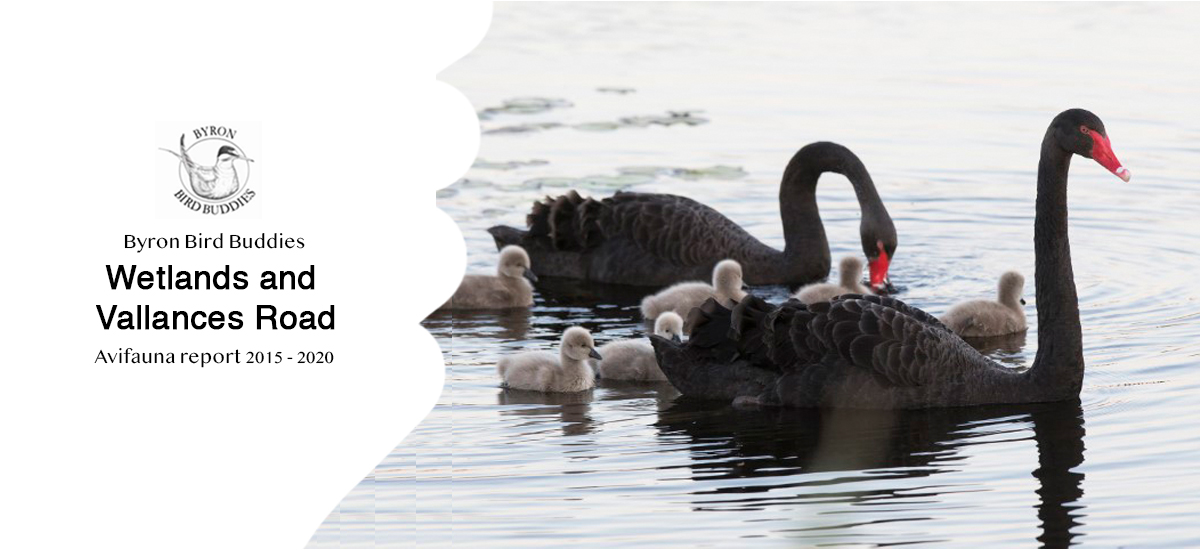
Report - West Byron Wetlands and Vallances Road Avifauna Survey
2010 – 2011
(posted 2-7-12)


For the past three years BBB have been commissioned by Byron Shire Council to monitor bird populations at Byron Wetlands and Vallances Road. The 2010 – 2011 West Byron Wetlands and Vallances Road Avifauna Survey builds on the two previous BBB reports aiming to determine trends in bird diversity and populations at these two sites and to provide recommendations for maintaining stable avifauna populations and to improve visitor education.
Briefly the two sites provide diverse habitats supporting a wide variety of bird species with a total of seventeen threatened species being recorded since year 2000.

Note - West Byron Wetlands was renamed Byron Wetlands in 2012

___

NORTHERN RIVERS REGION NPWS
SHOREBIRD BREEDING SEASON 2011-2012
(posted 2-7-12)


BBB in association with other volunteer groups, government agencies and local councils participate in shorebird conservation and observation from north of the Clarence River to the Tweed River. Information and results are shared between the groups and people involved at a bi-annual Regional Shorebird meeting.Holly North, NPWS ranger for the Richmond River area has collated the information and results of the 2011-12 shorebird breeding season into a report for the Northern Rivers area.


Download PDF Here

___


Feeding behaviour and diet of the Black-necked Stork.
(posted 2-7-12)


The Greg Clancy has supplied another paper on his study of the Black-necked Stork. This paper discusses nearly three years of observation on the feeding behaviour and diet of the Black-necked Stork.

Download PDF here

___


Information Sheets


·        As part of Byron Bird Buddies education program BBB have produced two information sheets regarding our coastal bird that inhabit important shorebird sites in Byron and Ballina Shires.

Brunswick shorebird information sheet final.pdf

Ballina shorebird information sheet final 1s.pdf

BBB members will be hosting on-site information stalls at a number of beaches during peak holiday periods to further provide information about the plight of the migrating and nesting coastal birds. Beaches and estuaries where the stalls are to be conducted will include Brunswick River Nature Reserve, Belongil Estuary, Flat Rock near Lennox Head and
Mobbs Bay, South Ballina in Richmond River Nature Reserve.

___

Data Sheets West Byron and Vallances Road


·        One of BBB’s projects includes the monitoring of bird populations at a number of sites in Byron Shire for a Byron Shire Council and Birdlife Australia. If you would like to look at the results recorded in an excel spread sheet for  2011 results for
West Byron Wetland and  Vallances Road
click on these links


___


Check out our new BBB Video links page.


Please click the link below to go our new video page where you will find links to several ‘fine feathered’ videos produced by friends and members of Byron Bird Buddies

Click Here